
The Guide
One manual. A hundred and six systems, built one weekend at a time.
Water, food, heat, cooking, power, light, sanitation, medical, security, communication, travel, and the long emergencies. Sixteen sections. Most systems are built in an afternoon with one hardware store trip, and the book tells you which ones to build first.
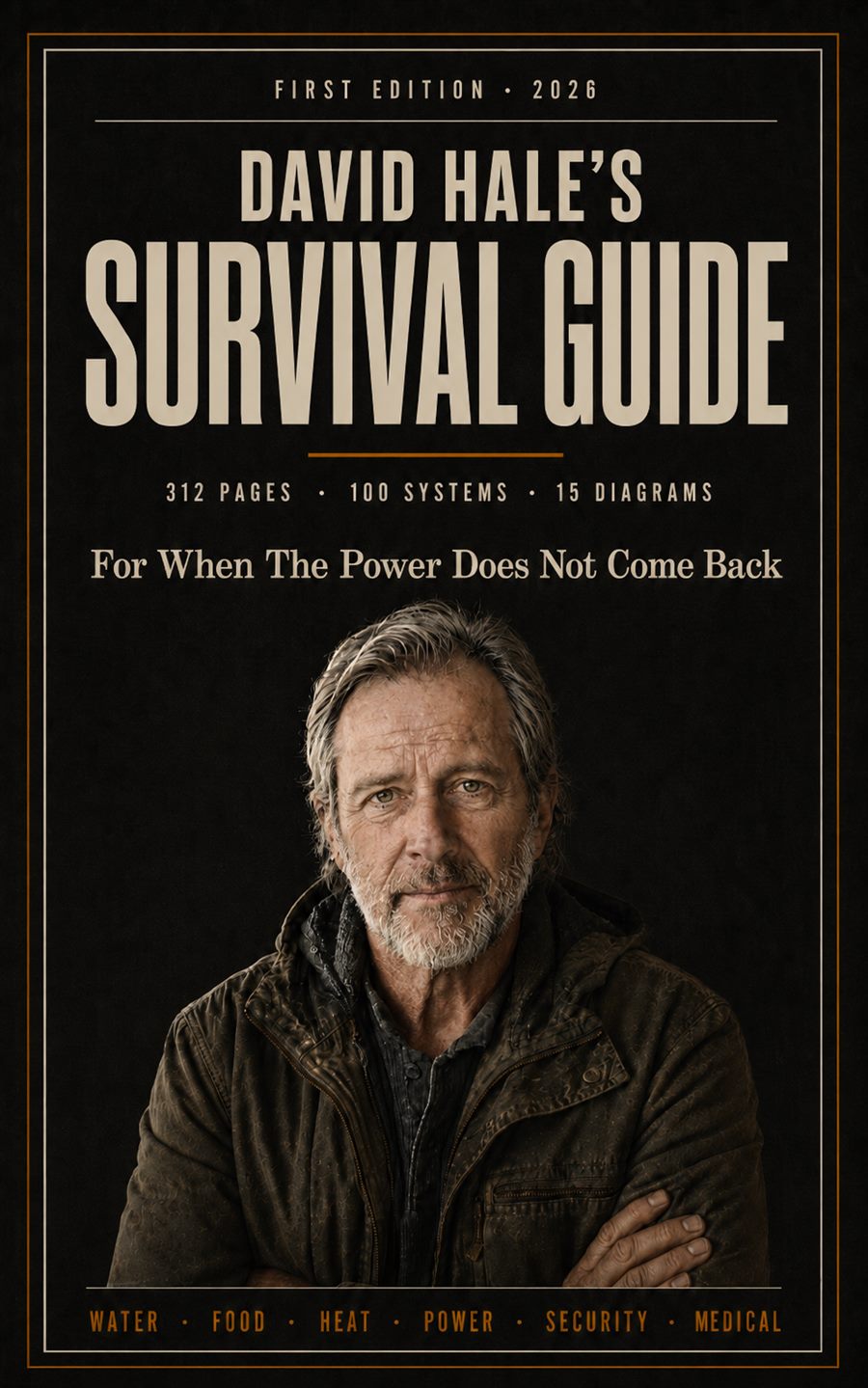
Illustrated PDF · 353 pages · 15 diagrams · Edition 2026
Everything your household needs when the grid fails, for however long it stays down.
The first twenty minutes, written to be followed under stress. The bathtub bladder: 100 gallons for $32. Choosing and sealing the one warm room when the furnace is dead in January. The refrigerator and freezer clock. Retained heat cooking that cuts fuel use 60 to 80 percent. The two-bucket system. Bleeding control with a real tourniquet, not a belt. One hundred and six systems, numbered №01 through №106, in the order you should build them, with exact materials and current 2026 prices for every one. It opens with ten scenario playbooks, nuclear detonation to earthquake, and closes with a one-page first-weekend build order.
What you get for $47:
- David Hale's Survival Guide: 353-page illustrated PDF, 106 numbered systems, materials lists, 2026 prices, step-by-step builds $47
- Ten scenario playbooks: each named event with its warning time, its timeline, and the exact systems to run, in order Included
- Two editions included: standard 6×9 and a phone-sized edition, same content, no pinch-zooming Included
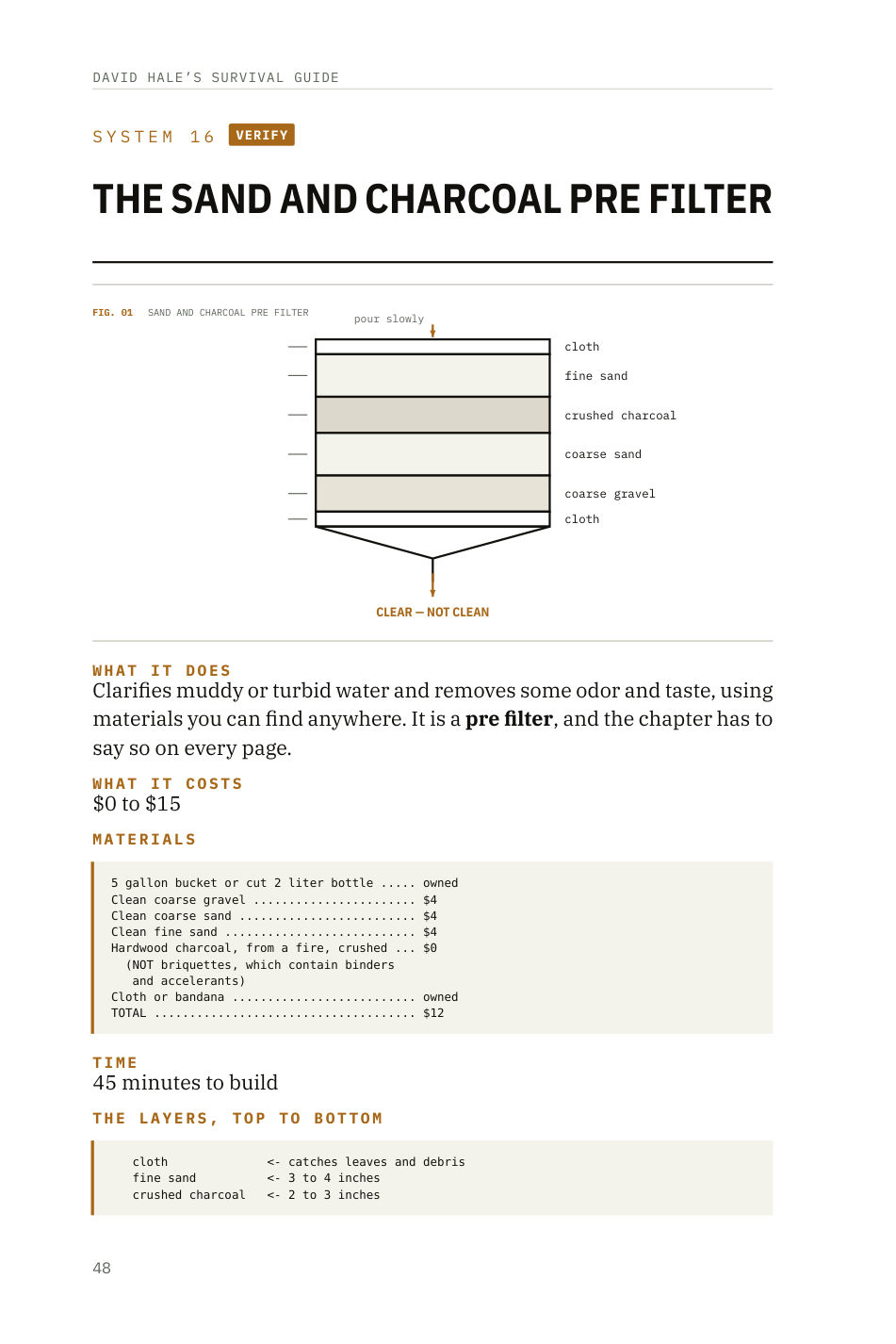
- 15 line diagrams: the filter stack, the rocket stove cross-section, door reinforcement, the two-bucket build, stove clearances, and ten more Included
- Edition updates: every revision of the 2026 edition, free Included
Instant download · Checkout by Gumroad · 7-day keep-the-book guarantee
Section 15 · The Front of the Book
Ten playbooks. Start with the one you fear.
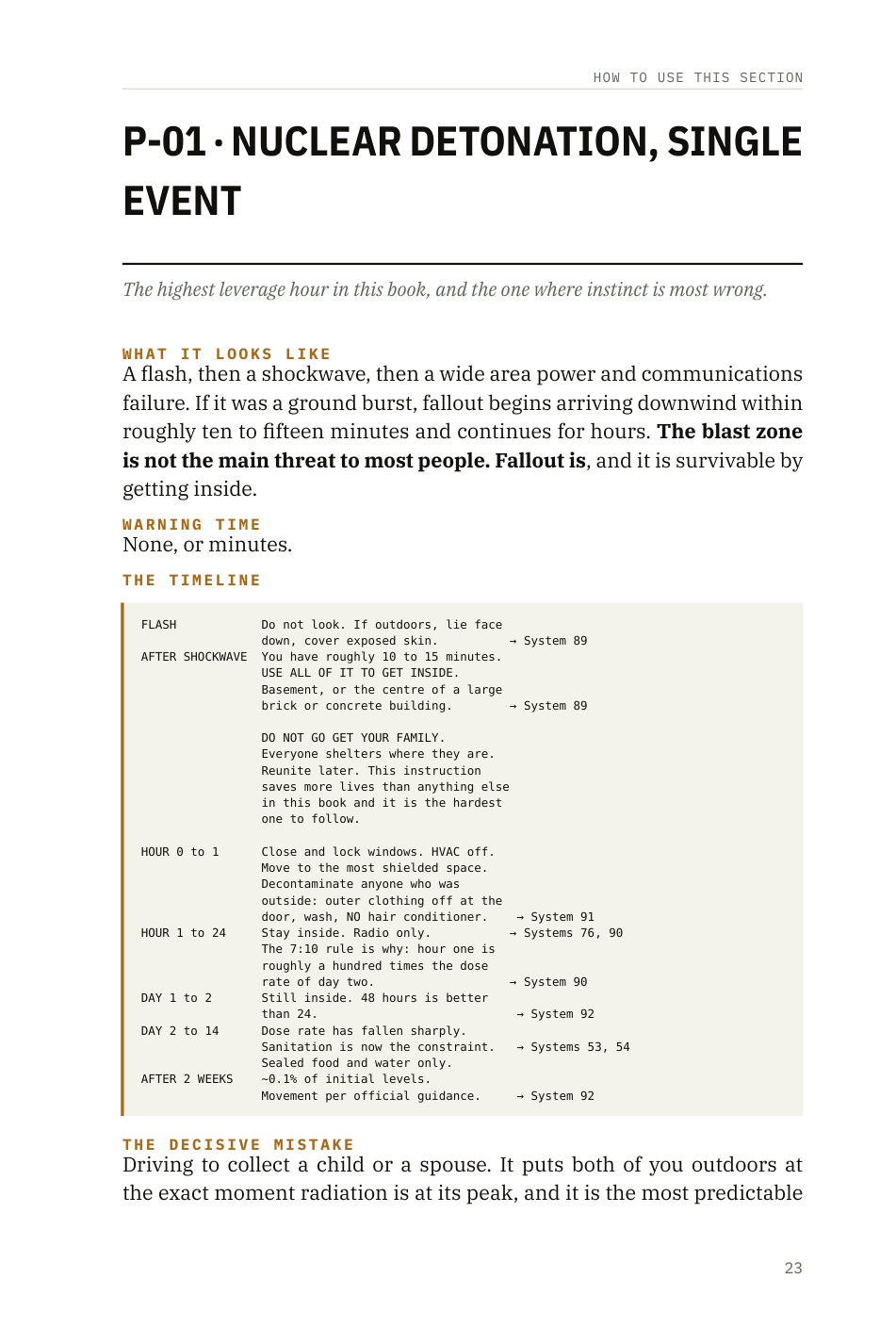
Nobody under pressure thinks "I need System 43." They think the sirens went off. Each playbook takes a named event and gives you what happens, on what timeline, and exactly which systems to run in what order, with the one decisive mistake that turns a survivable event into a fatal one.
- P-01Nuclear detonation, single event
- P-02Nuclear war or sustained conflict
- P-03Long duration infrastructure failure
- P-04Asteroid or comet impact
- P-05Pandemic
- P-06Regional grid failure
- P-07Hurricane or major coastal storm
- P-08Winter storm and ice
- P-09Wildfire and evacuation
- P-10Earthquake
P-01, the decisive mistake: driving to collect a child or a spouse. It puts both of you outdoors at the exact moment radiation is at its peak, and it is the most predictable way that prepared, loving people die in this scenario.
What's Inside
Exactly what you get for $47.
One hundred and six numbered systems and ten scenario playbooks across sixteen sections. Every title below is real and sits in the table of contents. Each system: what it does, the materials with current 2026 prices, the numbered steps, and an honest note on what it won't do. Build them in order or pick what your house needs first.
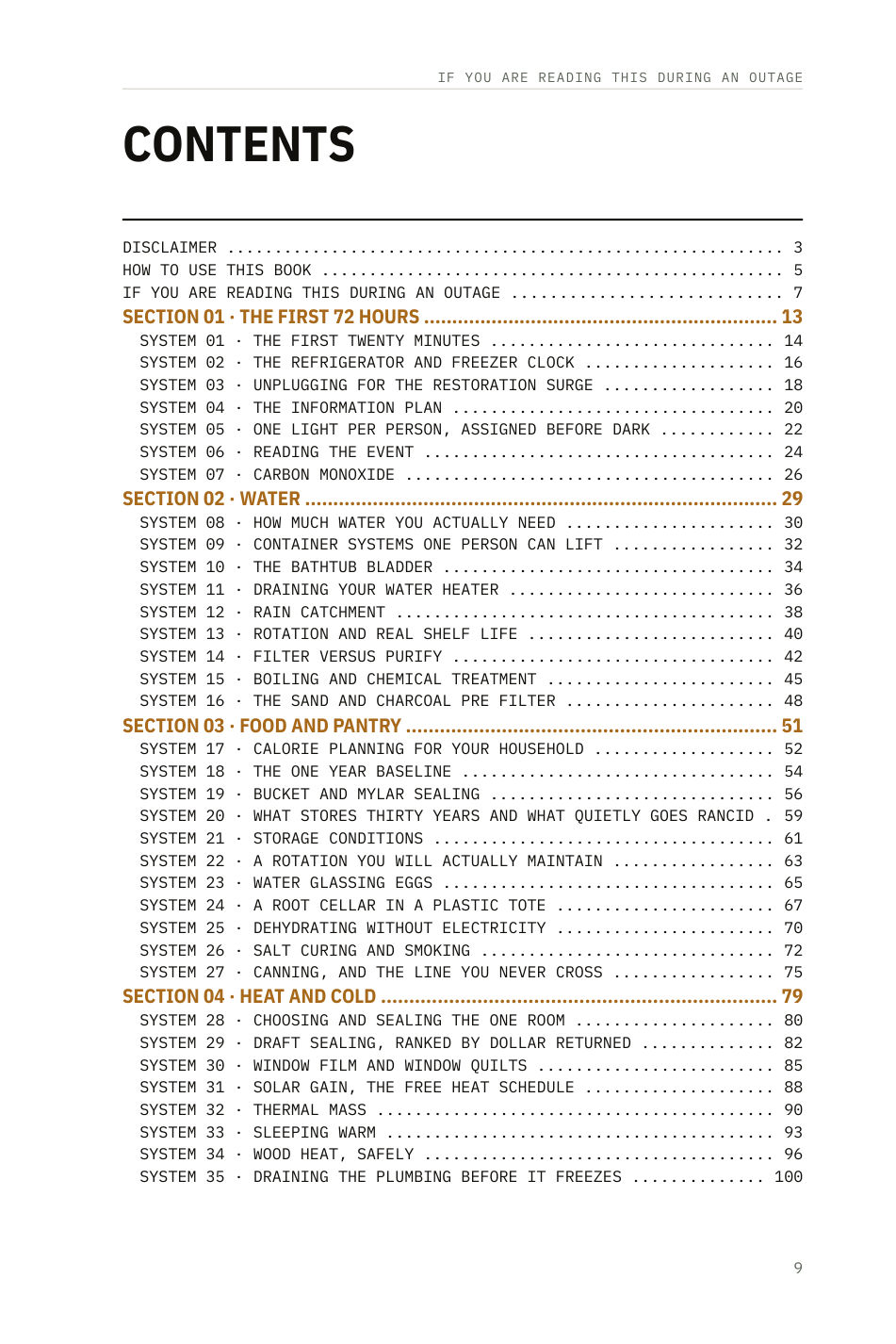
The first afternoon decides how the next thirty days go.
- The first twenty minutes
- The refrigerator and freezer clock
- One light per person, assigned before dark
- Carbon monoxide
How much you actually need, and where it lives.
- The bathtub bladder: 100 gallons for $32
- Filter versus purify, and the pore-size trap
- Boiling and chemical treatment
- Rain catchment
A one-year baseline built on buckets, not shopping trips.
- The one-year baseline
- Bucket and mylar sealing
- Water glassing eggs: 8 months, no fridge
- Canning, and the line you never cross
One warm room when the furnace is dead in January.
- Choosing and sealing the one room
- Draft sealing, ranked by dollar returned
- Sleeping warm: why the layer under you matters more
- Draining the plumbing before it freezes
Thirty days of hot meals on fuel you can store.
- Fuel math for thirty days
- The can rocket stove
- Retained heat cooking: cuts fuel use 60 to 80 percent
- The solar oven and its honest limits
Measure first. Then buy.
- Measure your loads first
- The starter setup
- The fridge-capable setup
- Triage: what to power and what to let die
Light you can sustain for months, not days.
- Oil lamps
- Rechargeable strategy
- Light discipline
The chapter nobody wants to need. Everyone does.
- The two-bucket system
- Handwashing: the highest-impact system in the book
- Laundry by hand
- Greywater and disposal
When the pharmacy is dark and the ambulance is busy.
- The kit that matches what actually happens
- Bleeding control
- Oral rehydration: six teaspoons of sugar, half a teaspoon of salt, one liter of water
- Children, fever, and when to worry
A poor target, not a fortress.
- Not looking like a target
- Door reinforcement
- Neighborhood mutual aid: why a lone hardened house is the weaker position
- Know the legal lines before you need them
Hearing news and reaching family with the towers down.
- The receive-only radio
- GMRS and the family license
- The written family plan
The honest chapter: leaving rarely beats staying.
- Bug in or bug out
- The bag most people pack wrong
- Walking fifty miles home
Month three, and after.
- Month three
- Rebuilding
The events measured in years, and the first one of them.
- Nuclear detonation: the first hour, where the right actions are free and instinct is wrong
- Fallout and the 7:10 rule: why patience is the strategy
- What potassium iodide actually does, and the four things it does not
- A failed growing season, and what 1816 teaches
- Growing food and saving seed in a cold year
- What actually held value in Cuba, Sarajevo, and Argentina
The bridge between the sirens and the systems.
- Arranged by severity, catastrophic first
- Warning time, the timeline, and the systems to run, in order
- Each closes with the decisive mistake
- Print two: the one you fear and the one you will actually face
The scenarios everyone else exploits, covered honestly.
- What an EMP actually destroys, and why your car probably still starts
- The real failure mode: transformers that take a year to build and barely exist as spares
- The household layer that has no electronics in it at all
- Governmental collapse as the five-stage degradation it actually is
- Sustained conflict, from documented civilian experience in Sarajevo and Ukraine
- Why the isolated household does worst, every time
The Honest Manual
What this book gets right that others don't.
This niche runs on inflated claims and recycled myths. The Guide's rule is simpler: check the number, cite the source, and say plainly what doesn't work.
An EMP does not turn every device into a brick.
- The real failure is that extra high voltage transformers are custom built, take a year to make, and barely exist as spares. Your car probably still starts
Potassium iodide is not a radiation antidote.
- It protects one gland from one isotope. Sheltering is what protects you
Post-disaster looting is largely a myth.
- Crime rates typically fall. The isolated households do worst, every time
A $300 solar setup runs lights, phones, and a radio.
- It does not run a refrigerator, whatever anyone tells you
The canning chapter refuses to guess.
- It will not print processing times it cannot stand behind. It routes readers to the USDA guide instead, which is exactly what the CDC advises
The Verification
Checked against primary sources.
Twenty-three safety-critical chapters, covering water treatment, canning, carbon monoxide, wood heat, generators, sanitation siting, radiation and fallout, and the entire medical section, were verified against published guidance from the CDC, EPA, USDA, FEMA, NFPA, WHO, the American Academy of Pediatrics, the American Dental Association, and the Committee on Tactical Combat Casualty Care.
A Straight Answer
Who this is for. And who should keep their $47.
This is for you if
- You live in a normal house or apartment and want your family covered for a real one-to-four-week outage
- You'd rather spend $60 and a Saturday than thousands in a panic
- You want instructions with prices and steps, not philosophy
- You want the systems in the order you should actually build them, not another gear list
- You're starting from zero. The Guide assumes nothing
This is not for you if
- You want tactical content: weapons training, combat scenarios, gear reviews. There are none
- You want doomsday entertainment. This book covers nuclear, EMP, collapse, and conflict seriously, using federal civil defence guidance, and it says plainly that these events are unlikely, that most preparation is boring, and that the lone hardened household is a losing strategy
- You already run a deep homestead setup. The first eight sections will be review
- You want entertainment. It's a reference manual, and it reads like one
The Author
Tested in a normal house, on a normal budget.

David Hale's Survival Guide is written for a normal house or apartment, on a normal budget, and it holds one rule: no claim goes on the page unless the number behind it checks out. Materials are priced at real 2026 retail, sources are listed in the back of the book, and where this niche repeats a myth, the Guide names it and shows the arithmetic instead.
The channel covers the same ground. The book is the reference version: one hundred and six systems in the order you should actually build them, ten playbooks that tell you which to run when, and the part numbers and prices a video doesn't have room for.
Field Manual FM-87 · Edition 2026 · Sources cited in the back matter
Order the Guide
$47 once. No subscription. Yours forever.
Instant download at checkout. Read on any phone, tablet, or computer. Print it at the kitchen table if you want. Every edition backed by the 7-day keep-the-book guarantee.
Illustrated PDF · 353 pages · 15 diagrams · Edition 2026
David Hale's Survival Guide
One hundred and six numbered systems and ten scenario playbooks, with materials lists, current 2026 prices, and the step-by-step. Build them in order, or pick what your house needs first.
- The complete Guide: 353 pages, 106 systems, 10 playbooks, 15 diagrams$47
- Two editions included: standard 6×9 and a phone-sized edition, same content, no pinch-zoomingIncluded
- Every update to the 2026 edition, freeIncluded
Instant download · Checkout by Gumroad · 7-day keep-the-book guarantee
Seven days. Full refund. Keep the book.
Read it for a week. If it isn't the most practical preparedness book you own, reply to your receipt email and Gumroad returns every dollar. You don't return anything. The PDF stays yours. All the risk here is ours, which is how it should be.
Questions
Asked often. Answered plainly.
Is this a physical book?
No. It's a PDF you download immediately after purchase. It's laid out to print cleanly at home or at a print shop if you want it on paper. Nothing ships.
Do I need land, a truck, or a lot of money?
No. Every system assumes a normal house or apartment. Most are built for under $50 each, many for under $20, and the Guide tells you the order to build them so the important ones come first. Renters are covered throughout.
Is this just the YouTube videos written down?
The channel covers the same ground; the book is the reference version: all 106 systems in one sequence, with the materials lists, exact prices, and step-by-step instructions a video doesn't have room for. It stands entirely on its own.
Are the prices actually current?
Every materials list was re-priced for the 2026 edition against major U.S. hardware and grocery chains. Prices drift, so treat them as close estimates for budgeting. The materials lists themselves don't go out of date.
What format is it, and what can I read it on?
A standard PDF, readable on any phone, tablet, or computer with no special app. Download it to your devices when you buy it. A copy that lives on your phone works with the power out.
What if it's not for me?
Seven days, full refund, no questions asked, and you keep the book. Refunds are handled by Gumroad from your receipt email.
While the lights are still on
The best time to have done this was last storm season.
The second best time is this weekend: one trip, under $60, three systems standing by Sunday night, and the other one hundred and three waiting in order.
Get the Guide · $47Instant download · Pay once · 7-day keep-the-book guarantee
Wait. One thing
One hundred and six systems. In order. $47.
353 pages: ten playbooks, nuclear detonation to earthquake, and the one hundred and six systems they run on. 7-day keep-the-book refund if it's not for you.
Get the Guide · $47